Strategy & Brand
AI website design: what it does well and what you decide
AI website design explained in plain words: what the tools do well, what a person still decides, and how a brand playbook keeps both on brand.
If you run a growing business, you've probably been pitched an AI website builder by now. Some of them are very good.
We use AI in our own work most days, so we're fans with a few reservations. This is where it saves you time, and where you want a person in the room.
AI website design in plain words
Most AI web design tools work the same way. You type a prompt like "a website for a family restaurant", or answer a few questions, and the tool hands back a layout, some copy and usually a few images.
It has learned from a huge number of existing websites. Restaurant sites tend to have a big photo, a menu, opening hours and a booking button, so that's what you get, in roughly that order.
The words work the same way. The tool predicts what usually sits on that kind of page, then drops in the details you gave it.
That's why it's fast and why it looks tidy. It's also why two restaurants typing the same prompt get two very similar AI generated websites.
What it hasn't done is meet your team. It hasn't heard how you answer the phone or seen the thank-you cards pinned up by the kettle.
Keep that in mind, because the strengths and the gaps come from the same place.
What AI tools do well
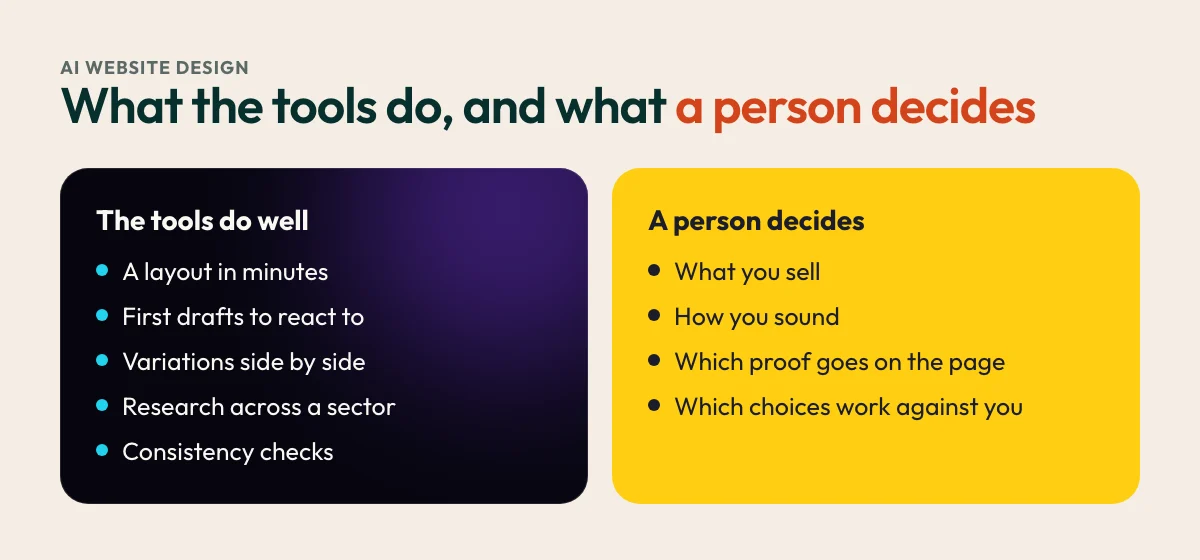
There are five, and we use most of them ourselves.
Speed
A tool can turn a prompt into a page layout in minutes. That used to take days of sketching, and it gives you something to point at and say "more like this".
First drafts
Headlines, menu descriptions, an about page: you'll have a version in seconds. Most of it needs rewriting, but a bad first draft is still a good way to find out what you don't want.
Variations
Ask for five hero layouts or three colour schemes and they arrive straight away. Seeing options side by side settles a debate faster than describing them.
Research
This is where we lean on AI most. It can summarise a sector, gather the questions customers keep asking and show what similar businesses put on their pages.
That saves hours of reading before a project starts.
Spotting the little inconsistencies
A tool can scan a whole site for odd button styles, spelling that drifts between British and American, or a phone number written two ways. It doesn't get distracted on page forty, which is more than we can say.
None of that decides what your business should say. That part comes next.
Four decisions that stay with people
A tool only works with what it's given, so these four are yours, with a bit of help from us.
What you sell
A prompt can describe your business in general terms. It can't know which service you'd love more of, or the one you'd happily stop doing tomorrow.
How you sound
AI writes in an average of everyone's voice. That's fine until a customer rings you and the person on the phone sounds nothing like the website.
How you talk is best decided by the people who do the talking.
Your proof
Real customers, real results and real faces belong to you. A tool will invent a testimonial before it admits it hasn't got one, so a person has to supply the evidence and check it.
The choices that cost you enquiries
Some things look polished and still put people off, like a stock photo where your team should be. Spotting those takes someone who has listened to what you want the site to do.
Listening comes first for us, and clients notice. This is Nicola Ayrton-Guest, Museum Director at the Household Cavalry Museum:
“From the outset, they took the time to really listen to us. They wanted to understand our weak points and appreciate our key goals, particularly around driving income through the website and ensuring a mobile-first experience.”
 Nicola Ayrton-GuestMuseum Director, Household Cavalry Museum
And Jon Tilt, a coach at Southampton Athletic Club:
“Chris & Ross listened to our requirements and translated them into something we could not have imagined ourselves. They even redesigned our club logo which now features on our club kit.”
 Jon TiltCoach, Southampton Athletic Club
Both of them are talking about being understood. That happens long before anyone opens a design tool.
See it for yourself: Sticky Duck twice
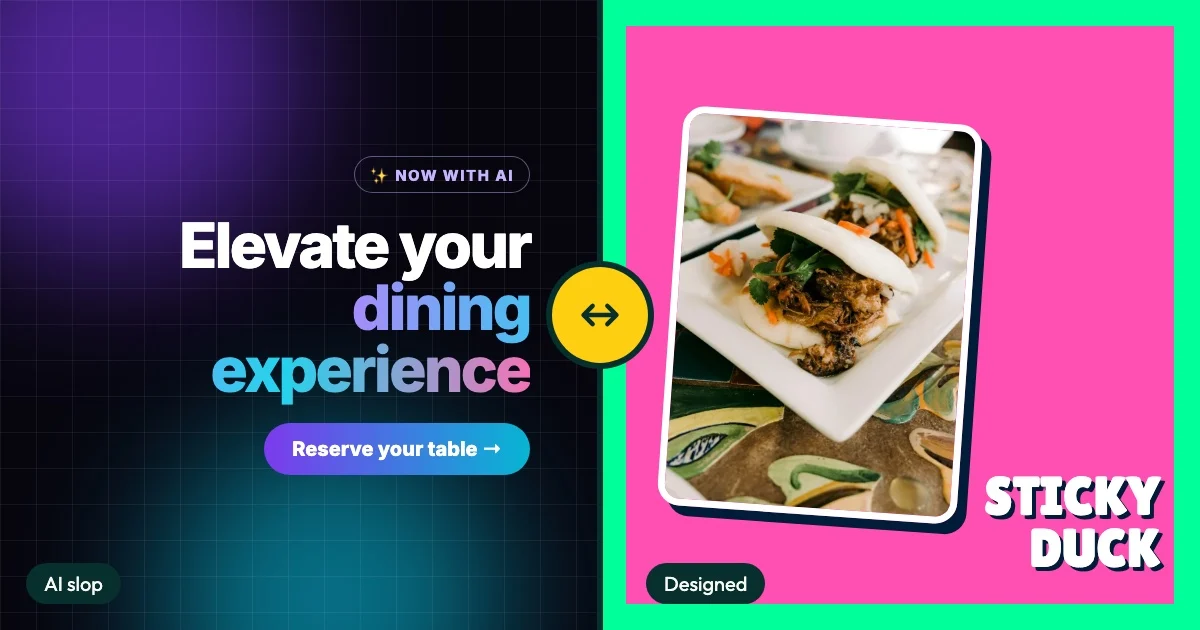
We made up a restaurant called Sticky Duck and built its website twice. Our AI website design demo puts both versions in drag sliders so you can compare them.
One side is what a single AI prompt tends to give you: a purple glow, "Elevate your dining experience" and numbers nobody can back up. The other is what our team designed from Sticky Duck's brand playbook, with proper food photos and the story of how it started.
The AI version works. It has a menu and a booking button, and it arrived in seconds. It could also be any restaurant, anywhere.
Try it on your phone too, because the gaps show up faster on a small screen.
Then ask yourself which one you'd send a hungry customer to. We'd love to hear your answer.
The brand playbook behind it
Every project we run starts with a brand playbook. We write it from stakeholder interviews with the people who run your business, plus questionnaires for your staff and customers, before anyone designs a thing.
It records what you sell, how you sound, who you want to reach and what you can prove. Everyone on the project works from the same answers, and that includes the AI tools.
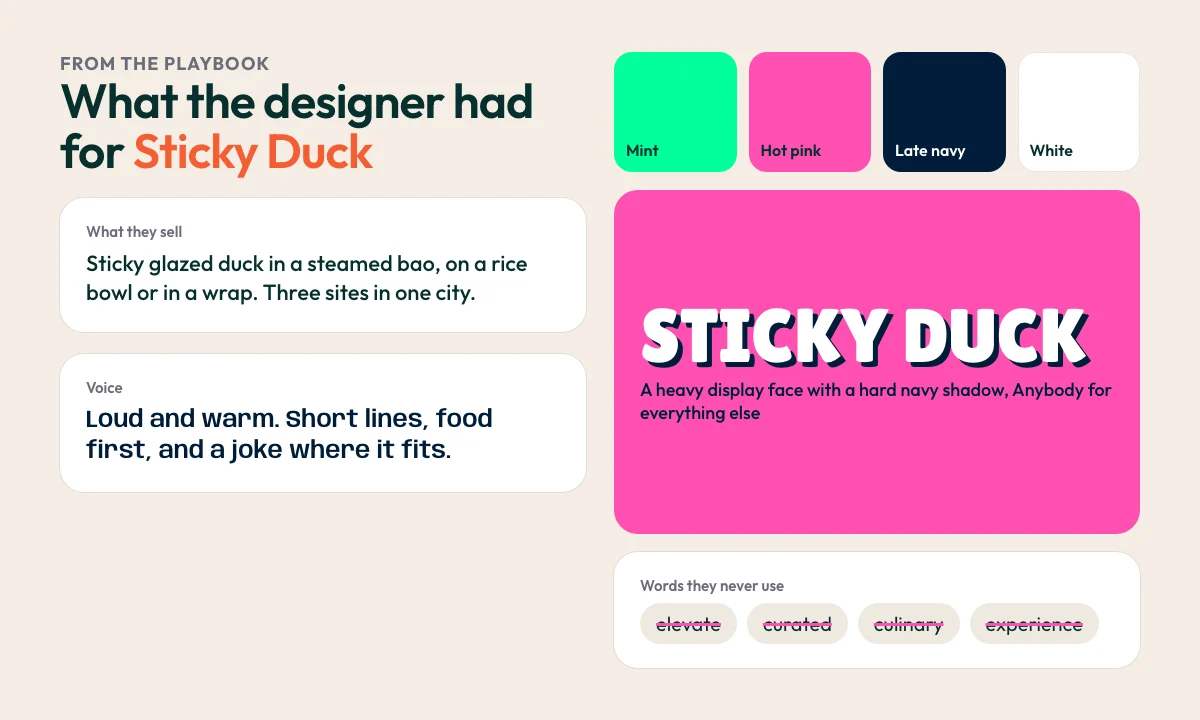
That's the page our designers worked from for Sticky Duck. The AI version had a single sentence to go on, and you can tell.
What it looks like for real clients
For Bridge Beauty we designed and built a WordPress site with video and photography at its heart, so customers get a feel for the salon before they step through the door.
At Southampton Athletic Club, the interviews shaped more than the look. This is Tracey Jones, the club's Chair:
“Rubber Duckers didn't just build us a website; they created a digital hub that truly reflects our club's spirit. The integrated functionality has transformed how we manage volunteers, records, and fixtures, making everything seamless.”
 Tracey JonesChair, Southampton Athletic Club
Those volunteer and fixture tools exist because we listened to the people who run the club week to week.
How we use AI ourselves
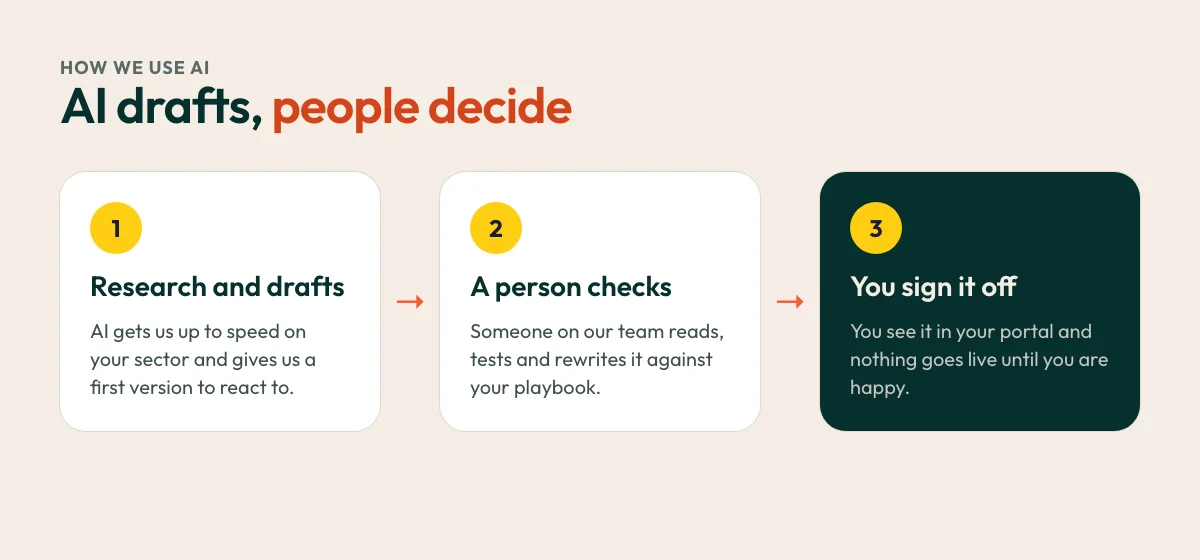
We use AI for two jobs: research and first drafts. It gets us up to speed on your sector quickly and gives us something to react to.
Then a person takes over. Someone on our team reads, tests and rewrites everything against your playbook, and nothing reaches you until they're happy to put their name to it.
What we say about you, how it sounds and which proof goes on the page all come from your interviews. We talk each of them through with you.
If this is your first website project, that's fine. You'll know what's next at every stage, and your feedback goes in one place so nothing gets lost in an email thread.
Natalie Meagher, Head of Housing at PHA Homes, was in exactly that spot:
“Until this project, I had not been involved in developing a new website, IT related work has never been my strength, however, you have helped make the process both a smooth and interesting one.”
 Natalie MeagherHead of Housing, PHA Homes
Where AI saves time, the time goes back into the parts that need a person, like listening to your team, the creative thinking and checking the details. We'd much rather spend an hour on your tone of voice than on typing out a first draft.
Book a discovery call
Book a discovery call and we'll talk through your project. You don't need a brief or anything technical.
We'll ask what you sell, who your customers are and what you want the website to do. We'll also explain how the playbook would work for your team.
Video, photography and support after launch come up too, so nothing turns up as a surprise later. You'll leave knowing what the first steps look like, and then you can decide whether we're the right fit.
Add us as a preferred source on Google.
If this article has been useful, let us know!
Book a free intro call to talk through your needs.