Strategy & Brand
How long does a website take to build?
12 to 16 weeks is the honest average for a bespoke business website. Here's the stage-by-stage breakdown, and the one thing that derails timelines more than anything else.
The honest average is 12 to 16 weeks for a bespoke business website, from kick-off to launch. Faster is possible if everything aligns. Slower happens more often than the industry likes to admit, and it's almost always for the same reason.
Here's the real breakdown, the stages, and what actually controls how long the whole thing takes.
The standard timeline, week by week
For a typical service business site with a properly bespoke build, the stages roughly land like this:
- Discovery: 2 weeks
- Design: 2 weeks
- Development and visual content: 10 weeks
- Testing and launch: 1 week
Add a small buffer for sign-off windows and you're at 15 to 16 weeks for most projects. That's not because the work itself takes that long in pure hours. It's because real projects have feedback rounds, content production days, stakeholder availability, and the inevitable two or three things that need a second look.
The 10-week development window is the part that surprises people, because they assume "building the site" is the longest stretch when it's actually shared with content production. Photography days, video shoots, copy refinement, and CMS population all happen in parallel with the build, and they all need to land in roughly the right order for the project to flow.
What can speed it up
Smaller sites move faster. A 6-page site with no video content, existing photography, and copy ready to go can ship in 6 to 8 weeks comfortably. We've shipped good work in less than that when the brief was tight, the client was decisive, and the surrounding pieces were already in place.
Decisive clients move faster than indecisive ones, by a wide margin. Projects where the marketing manager has the authority to sign things off without escalating each round will routinely come in 2 to 3 weeks ahead of projects where every decision needs a committee.
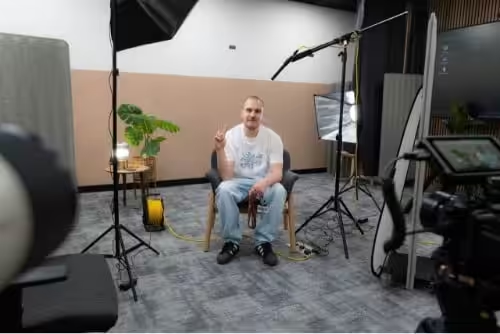
Doing more of the content production in-house also helps, which is part of why we've moved as much as we can under our own roof. When the photographer, the designer, the developer, and the project manager are all in the same team, the coordination overhead drops significantly and the project moves at the pace of the work, not the pace of the calendar invites.
What slows it down
Content. It's almost always content. Either the copy isn't ready when the build needs it, or the photography hasn't been organised, or the video hasn't been planned and now needs a shoot squeezed in.
The pattern repeats so consistently that it's now the first thing we discuss in onboarding. If the client is providing copy, we want it before the build starts, not "alongside" it. If we're writing the copy, we still need source material from the client, and that source material needs a real owner and a real deadline. If photo or video is in scope, we want shoot days in the calendar before development begins, not slotted in when there's a gap.
The other big one is feedback engagement. Clients who use our feedback tools properly, leave comments directly on designs, and turn things around in a couple of working days will see their projects move smoothly. Clients who let feedback sit for a week, then send it as a long email with conflicting opinions from three people, will lose time that's almost impossible to claw back.
The realistic version
If you're planning a website project and someone is quoting you 8 weeks for a full bespoke build with original content production, ask what they're cutting to make that timeline work. It's not impossible, but it usually means a smaller scope than you think you're getting.
12 to 16 weeks is what it actually takes when the work is being done properly and the surrounding content is being produced rather than assumed. Faster is possible when the conditions are right. Slower is what happens when content production is left to chance.
Our process page covers how we structure each stage, and our pricing post covers what each phase typically costs.
If this article has been useful, let us know!
Most of the timeline questions we get asked are really questions about content readiness in disguise. If you’ve got a project on the horizon and want to talk through how to plan it so it actually ships on time, we’re happy to share what we’ve learned from running a lot of these and what we’d organise differently from the start.
Book a free intro call to talk through your needs.